WELCOME TO THE WELL!
Isobel denied ever practicing witchcraft and instead claimed that the conflicts between her neighbours and herself were of an ordinary nature. Yet, George Smith, her husband, testified against her before the presbytery in 1624 and again at trial in 1629 for ‘attempting to kill him with magic after quarrelling about an unsavoury house guest.’ Furthermore, the historical record indicates that ‘forty-five of her neighbours and relatives, including her husband, testified against her, telling a story that unfolded over four decades.’ Despite her insistence on being a good, moral Christian woman that would not hurt or ill-wish her neighbours, she was found unanimously guilty on only one charge, witchcraft.” The Story of Isobel Young, University of Edinburgh.
What is this blog about?
During my many trips to the beautiful city of Edinburgh and further north, to the Scottish highlands and islands, I often thought “this moment feels like magic”. Sometimes it was when I was standing in a little book shop, where every inch of every (sometimes wonky) wall was covered in books, or sipping tea in a beautiful small cafe where I sat on a cushion in an alcove under a ornate late gothic arch, or when I was standing on the top of a Munro looking over a moody landscape with a few sun rays making their way through the thick clouds.
Then, in 2023, I came across a podcast by the BBC: “Witch“. And couldn’t stop thinking about what magic means to so many different people, what it meant historically. And most of all, what it meant for people, especially women, to be accused of wielding magic, of being witches: death.

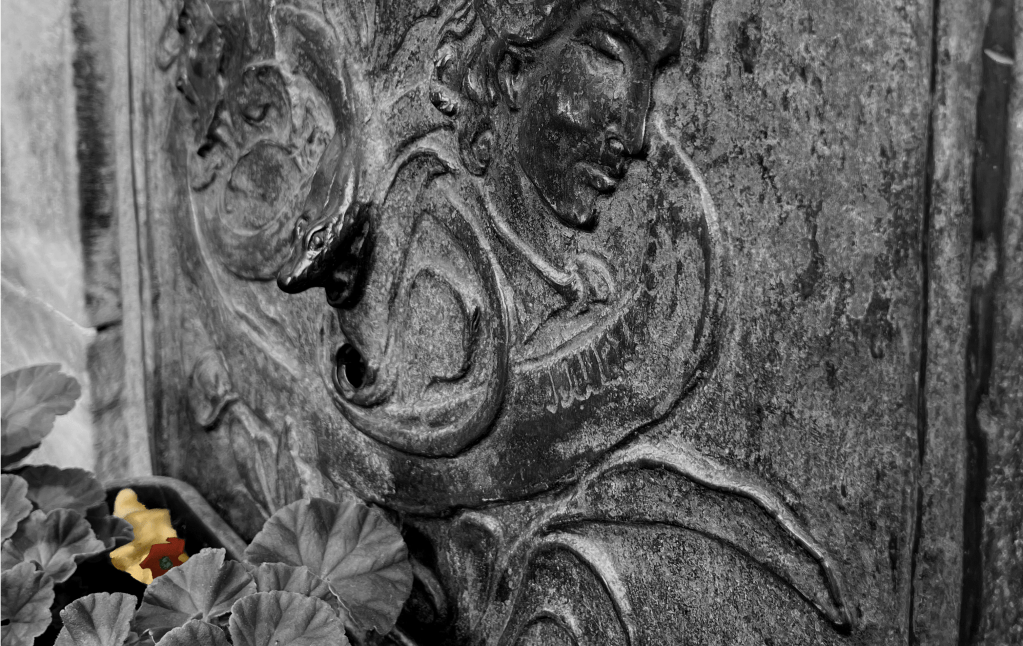
So, on my next trip to Edinburgh, I looked up a commemorative fountain, called “Witches’ Well”, to find out more about the people who lost their lives because they were accused of being witches. What I found surprised me: the fountain was tiny, right next to a busy tourist attraction but out of sight enough that in the time I spent there, no one else looked at it. It was also dried up, the water basin occupied by a cheap plastic plant pot with a few green geranium inside. I took a few pictures (none of them particularly good) and left.
In the evening, I looked through my pictures to choose a few to post on Instagram, and I saw someone had dropped an apple core in one corner of the planter. From the angle I took the photo from, it looked like the snake was hissing at the apple core. The symbolism of it hit me. According to the information board next to the well, hundreds of people were tortured and killed in Edinburgh, yet the tiny, forgotten well remains the only known monument to them in the city. And a discarded apple core in the well, “stared at” by a snake? Well, I think you can see where this is going.
On the train to Stirling I used the time to work on the picture I had taken, first turning it black-and-white and then coloured in the apple core. And I decided to keep my eyes open for traces of the people that were killed in witch trials and write about them in my travel diary. When I spoke to a friend about it, she suggested I turn the diary into a blog, and here we are.
I chose “The Well” as the name for the blog, one, because a well inspired it, and two, witches and wells have a long and cruel shared history. This digital well, however, will be filled with drops of stories, history and encounters with traces of “witches” rather than water.
This blog will grow very, very slowly: whenever I come across a trace, I will post about it. And if you have made it this far: thank you for reading and let me know about the traces you have encountered!
Your message has been sent

 The Well